
Deloitte 2026 Oil and Gas Industry Outlook: Summary & Key Takeaways


The 2026 oil‑and‑gas landscape is defined by shifting U.S. policies, tariff‑driven cost pressures, and accelerating digital transformation. Deloitte’s annual industry outlook notes that companies showed resilience during 2025’s turbulent macro environment but at the cost of slower growth and tighter margins.
Five themes frame the year ahead: growth priorities, cost pressures, scaling U.S. LNG, digital transformation, and rebuilding downstream. Below is a concise overview of these trends and what they mean for pipeline operators and industry insiders.
1. Growth priorities: policy tailwinds but cautious investment

Supportive federal policies:
In 2025 the U.S. administration expanded federal land access, streamlined permitting, and offered fiscal incentives such as reduced royalties and bonus depreciation. These moves supported drilling access, production, and capital relief. The outlook expects additional measures in 2026 to bolster U.S. shale acreage and LNG projects, while oil‑focused companies remain cautious.
Modest growth expectations:
Deloitte projects only 15–25% of listed U.S. oil‑and‑gas firms will achieve revenue growth above 5% in 2026. Natural‑gas producers and LNG developers are likely to increase investment amid data‑center demand and supportive export policies, whereas oil producers emphasize free cash flow and dividend discipline.
Portfolio restructuring and capital discipline:
Nearly 70% of U.S. O&G companies plan to divest non‑core assets and restructure portfolios. Between 2022 and mid‑2025, 45% of sector cash flow went to dividends and buybacks. Companies are expected to leverage full expensing, bonus depreciation, and 45Q credits to improve returns, but the outlook cautions that growth will be uneven.
Implications for operators:
Although spending discipline tempers near‑term volumes, supportive leasing policies and tax incentives should generate a steady pipeline (pun not intended) of new projects. Operators should track federal lease auctions and plan camp capacity accordingly.
2. Cost pressures: tariffs reshape supply chains

Tariff headwinds:
As of October 2025, the U.S. imposed 10–25% tariffs on non‑USMCA crude feedstocks and raised Section 232 steel and aluminum tariffs to 50%, extending them to equipment like compressors and pumps. Tariffs on steel, aluminium, and copper could raise material and service costs by 4–40%, compressing margins across upstream, midstream, and downstream businesses.
Investment deferral:
With limited ability to pass through higher costs, operators may delay large capital projects; Deloitte warns that offshore greenfield FIDs exceeding US$50 billion could slip. Companies will increasingly secure supply through domestic or non‑tariffed vendors, adopt modular fabrication, and use flexible contracts with escalation clauses.
Implications for operators:
Pipeline and housing providers should anticipate longer lead times and higher costs for steel pipe, compressors, and camp materials. Strategic procurement can mitigate delays and ensure continuity.
3. Scaling U.S. LNG: policy support and structural risks
Fast‑tracked approvals:
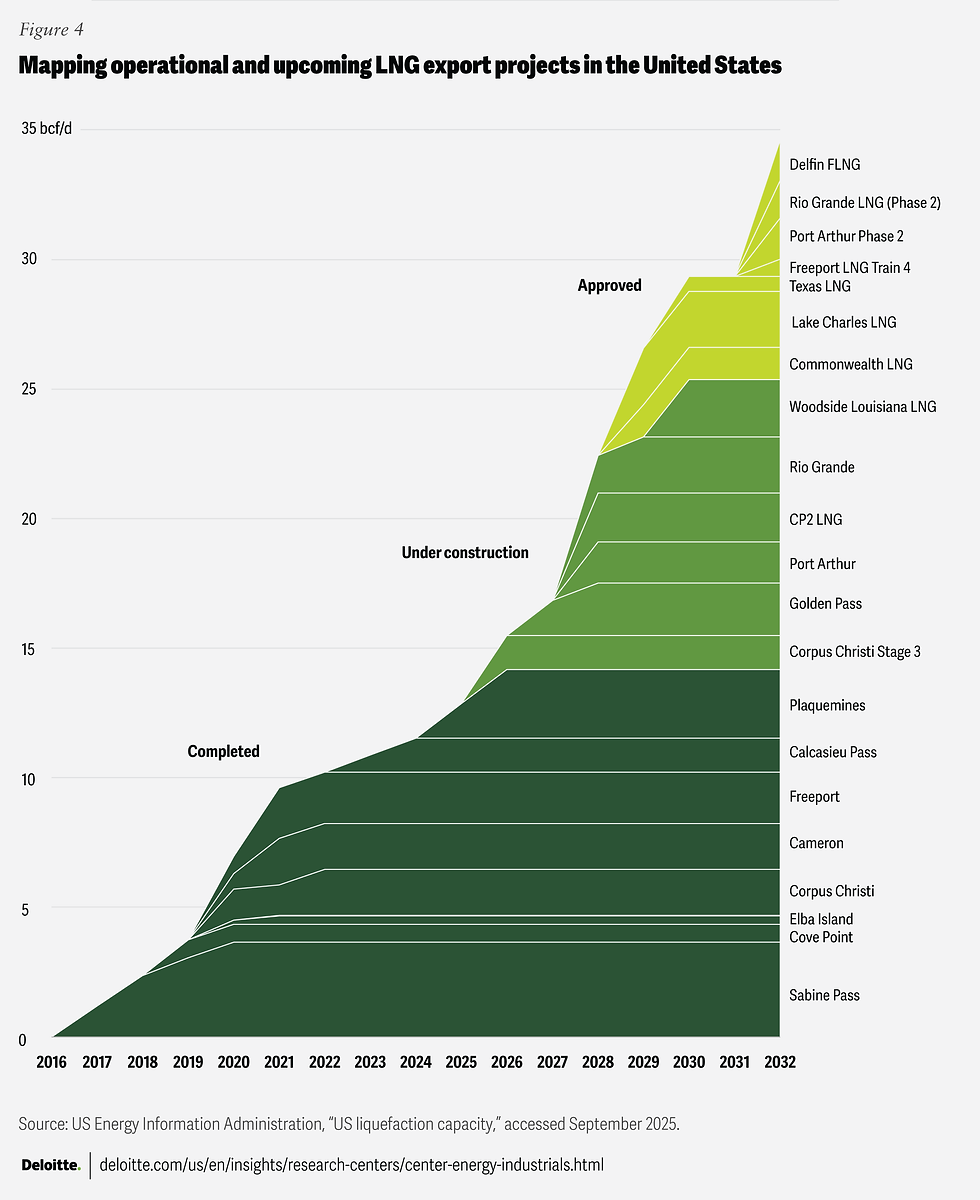
The U.S. lifted its pause on non‑FTA LNG export approvals and accelerated permitting, cutting environmental review times from two years to around 28 days. As a result, U.S. LNG exports are projected to rise 25% in 2025 and 7% in 2026, with capacity doubling by 2030 if all projects proceed. LNG demand could grow 60% by 2040.
Structural challenges:
New construction faces headwinds; rising EPC costs (up 4.6% YoY) and potential oversupply from Qatar, Australia, and Canada may delay FIDs. Low oil prices could limit associated gas output, raising domestic gas prices, and eroding LNG netbacks; each 1 bcf/day increase in exports above sanctioned levels may boost U.S. gas prices by ~2.5%. Spot‑based LNG contracts rose from <10% to >30% by 2024; new capacity may return to long‑term contracts.
Implications for operators:
LNG growth supports new pipelines and storage terminals, driving demand for remote camps. Yet volatility in gas prices and construction delays demand flexible logistics. Operators should monitor export approvals and supply chain risk to time investments.
4. Digital transformation: AI and integrated operations

Flat productivity and rising costs:
New‑well oil output per rig increased less than 2% between June 2024 and June 2025, while tariffs added 2–5% to costs. Digital solutions—from AI‑powered drilling analytics to generative AI—account for less than 2% of O&G IT spending today but could exceed 50% by 2029.
Operational gains:
Predictive algorithms have saved 140 hours of downtime and improved uptime by 1.6%. Integrated operations using SCADA, AI‑enabled field services, and digital twins improve uptime and resilience, vital as LNG exports double. Prescriptive maintenance and robotics can reduce failures by up to 40% and save US$10 million. AI‑enabled training and remote connectivity help bridge workforce gaps for mechanical roles. Environmental monitoring—sensor networks, drones, and real‑time analytics—is essential as methane regulations tighten.
Implications for operators:
Pipeline and camp operators should invest in digital tools for predictive maintenance, supply chain visibility and remote workforce training. Data‑driven planning can optimise camp sizing and reduce downtime.
5. Rebuilding downstream: feedstock, capacity, and renewable fuels

Policy support for petroleum and renewables:
Relaxed Corporate Average Fuel Economy standards and the sunsetting of EV incentives could sustain gasoline and diesel demand, while higher renewable blending mandates and extended 45Z tax credits underpin growth in renewable diesel and sustainable aviation fuel (SAF).
Feedstock strategy & capacity rationalization:
Tariffs on non‑USMCA crude may widen the WTI–WCS spread and encourage diversification of feedstocks. U.S. refinery capacity could shrink by ~3% as 400 kb/d of capacity is closed or converted and another 120 kb/d converted to alternative fuels. Refiners must optimize throughput and target high‑margin products while navigating new global capacity additions.
Renewable diesel and SAF growth:
RD output may reach ~250 kb/d by 2026 due to Renewable Fuel Standard obligations and 45Z incentives, but margins could be pressured by feedstock competition. SAF adoption remains slow because of high costs and feedstock constraints. Climate disclosure rules and Low Carbon Fuel Standard volatility create regional opportunities but add complexity.
Implications for operators:
Midstream operators should anticipate shifts in feedstock flows and invest in pipeline flexibility to handle diverse crude and renewable feedstocks. Workforce housing providers can prepare for increased construction activity at refinery conversion projects.
Takeaways for pipeline and remote‑housing leaders
Watch federal and state policy signals. Expanded leasing, tax incentives, and fast‑tracked permits create opportunities for new pipelines and camps; however, tariff‑driven cost inflation may delay projects. Stay engaged with regulatory updates and adjust budgets accordingly.
Strengthen supply chains. Diversify suppliers, consider domestic manufacturing, and adopt modular construction to offset tariffs and material shortages. Use digital supply‑chain platforms for real‑time visibility and contract management.
Leverage data and AI. Deploy predictive maintenance, SCADA integration, and AI‑enabled workforce training to boost uptime and efficiency. Digitally monitor camps for safety compliance and methane emissions.
Plan for LNG growth and volatility. Align camp and logistics capacity with expected LNG project timelines; be ready for four‑to‑five‑year construction lags and potential price volatility. Consider flexible contracts that adapt to market swings.
Position for energy transition. While petroleum demand persists, renewable diesel, SAF, and carbon‑capture projects will expand. Offer logistics and housing solutions for hybrid projects that blend hydrocarbons with low‑carbon technologies.
Conclusion
Deloitte’s 2026 outlook underscores that agility and discipline will define success in the coming year. Policy winds are favourable, but tariffs and inflation require cost vigilance. LNG’s surge and digital innovation present growth avenues, while downstream restructuring and renewable fuels point to a more diversified energy mix. For pipeline operators and remote‑camp providers, the message is clear: prepare for expansion, control costs, and leverage data to stay ahead.
At Karavan Trade Partners, we specialize in sourcing, logistics management, and workforce housing that keep crews comfortable and projects on schedule—whether you’re laying pipelines, expanding LNG terminals, or upgrading refineries. Contact us today to discuss how we can support your next energy project with agile, resilient solutions.


Comments